
What Are Action Words?
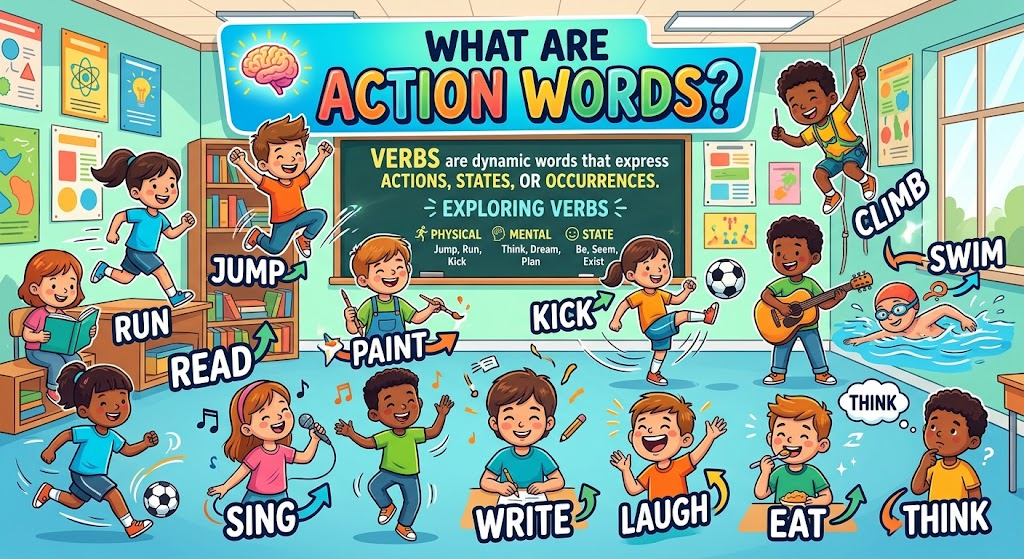
Action words are the life of any sentence we write or speak every single day. They tell us what a person, animal, or even a magical creature is doing right now. Without them, our sentences would feel totally empty and very boring to read. Think about words like run, jump, skip, and play. These power words bring energy to our stories and help us paint clear pictures in our heads. When we talk about actions, we also have to think about time. Does the action happen every day, or is it happening right this second? That is where special action words come into play to save the day. Today, we are going to look closely at two very special action words that you use all the time without even realizing it. They are the words put and putting. Learning how to use them correctly will make your writing shine like a bright star!
Table of Contents
Meet the Word Put
Let us start by looking at our first fun word, which is simply put. This word is a short action word that we use to describe placing something somewhere. For example, you might put your heavy school backpack down on the living room floor. Or maybe you like to put your favorite blue hat on your head before walking outside. The cool thing about this word is that it tells us the action is done or happens regularly, but it stays nice and short. It does not need any fancy extra letters at the end to make sense in a sentence. You can put a toy in a box, put a book on a shelf, or put a smile on your face. Every single time you move an object to a new spot, you get to use this word. It is a super helpful tool in your writing toolbox that helps you explain clear steps to your friends and teachers.
Understanding the Word Putting
Now it is time to meet the exciting partner word, which is putting. This word looks a lot like our first word, but it has a little extra sparkle added right at the end. We use putting when someone is in the middle of doing the action right now. For example, if your mom walks into your room and asks what you are doing, you might say you are putting your markers away. Notice how the extra letters show that the action is happening at this exact moment in time. You could be putting a puzzle piece into its correct spot or putting a sweet topping on your favorite ice cream scoop. This word helps readers feel like they are standing right next to you, watching the action unfold live. It adds great movement and excitement to every single story or paragraph that you decide to write down.
How to Choose the Right Word
Choosing between put and putting is actually a super fun game once you know the secret rules. All you have to do is look at the time and ask yourself a quick question. Is the action happening right now, or is it something you do normally? If you are doing it right this very second, grab the word with the extra ending. If it is a general action or happened already, keep it nice and simple with the shorter version. Let us practice together with a quick example from everyday life at home. Right now, you might be putting your shoes on your feet to go play outside. Yesterday, you simply put those same shoes by the front door when you came inside. See how easy that is? Paying close attention to the clock inside your head helps you pick the absolute best word every single time.
Fun Examples in the Kitchen
The kitchen is one of the best places in the whole house to practice using our favorite action words. Imagine you are helping bake some delicious chocolate chip cookies with an adult family member. You will definitely need to put all the yummy ingredients into a big mixing bowl. First, you put in the flour, then you put in some sugar, and finally you put in the chocolate chips. While you are doing all of this hard work, someone might walk by and say you are putting together a masterpiece. You might even be putting the tray inside the warm oven to bake until golden brown. Kitchen adventures give us so many chances to use these words correctly. Cooking and baking make learning grammar taste sweet and feel like a fun game instead of a boring school lesson.
Adventure Time: Putting Together Puzzles
Puzzles are another fantastic way to see these action words working hard in real life. When you open a brand new puzzle box, you first put all the colorful cardboard pieces flat on the table. Your eyes search for the corners so you can put them together to make a solid outer frame. As the big picture starts to grow, you find yourself putting the final center pieces right where they belong. Every time you successfully put a piece into place, you feel a big wave of proud excitement. It takes focus, patience, and a lot of active problem-solving skills to finish the whole challenge. Without realizing it, your brain is actively mastering language skills while you play. Puzzles prove that learning new words can be an awesome adventure filled with bright colors and fun discoveries.
School Days and Backpacks
Think about your typical busy morning rushing out the front door to catch the big yellow school bus. You have to put on your jacket, put your lunchbox inside your bag, and put your pencils in your case. If your teacher asks why your desk looks so neat, you can say you are putting your supplies away nicely. Throughout the school day, you are always putting your thinking cap on to solve tricky math problems. You might even be putting your creative ideas down on paper during fun writing time. These daily routines give us endless opportunities to practice our vocabulary without even trying very hard. School is a bustling hub of activity where action words live and breathe in every single classroom corner.
Sports and Outdoor Games
Outside on the playground or the sports field, action words are zooming around faster than a speeding racecar. If you love playing golf, you know that the final goal is putting the tiny ball into the cup. In baseball, a player might be putting all their strength into hitting a grand slam home run. When recess is finally over, teachers will remind everyone to put the playground balls back in the big bin. You might even be putting your winter gloves on if the chilly wind starts blowing outside. Sports keep our bodies moving and give our minds wonderful stories to tell our friends later. Action words help us capture that sporty energy so our stories sound alive, thrilling, and full of exciting motion.
Handy Biography Table
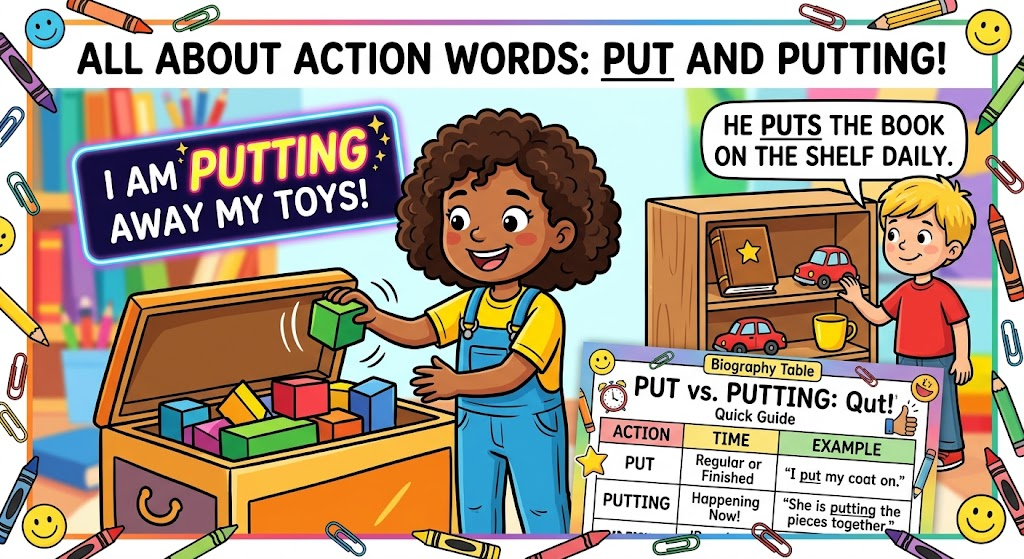
To help you remember everything we talked about, here is a quick and helpful comparison table.
| Feature Word | When to Use It | Fun Example |
| Put | General actions or past habits | I put my toys in the box. |
| Putting | Actions happening right now | I am putting my toys away. |
Conclusion
Learning how to use action words like put and putting correctly is a fantastic superpower for any young writer. By paying attention to when things happen, you can make your stories clearer, more engaging, and fun to read. Keep practicing these words in your daily journaling, school assignments, and fun storytelling sessions at home!
Frequently Asked Questions (FAQs)
1. What is the main difference between put and putting?
The main difference is time. We use put for general or past actions, while we use putting for actions happening right now.
2. Can put ever change its spelling in the past tense?
Surprisingly, no! The word put stays the exact same whether you are talking about yesterday, today, or tomorrow.
3. Why does putting have a double t?
We add an extra letter and an -ing ending to show that an action is continuous and happening at this exact moment.
4. Are these action words easy to use in stories?
Yes, they are very common words that help you describe moving objects from one place to another smoothly.
5. Can I use putting without a helping verb?
Usually, putting needs a helping word like “is,” “am,” or “are” right before it to make a complete sentence.
6. Where can I practice using these words?
You can practice right at home by describing what you are doing while cleaning your room or making snacks!